


Explore the Eras
800 AD
to 2000
Sennachie
Angus McCoss is an independent researcher whose interests focus on the interwoven nature of Highland and Lowland Scottish history, and its genealogical fabric. His Doctorate in Geology is underpinned by a fascination with interpreting fragmentary records of the past, a discipline that informs his interests in archaeology, history, and genealogy.

Name & Motifs

Name
Clann Mhic Eòs' (pronounced kLauN vikh YOH-s) derives its name from our forefather in the Braes of Mar - a respected Brabant veteran hagbuttar (arquebusier) - called Eòsaph 'Joos' Brabner (c.1555-1630). The Gaelic patronymic, MacEòsaiph, was shortened to MacEòs' (pronounced mak YOH-s). The evolution of the name by Scots-speaking scribes generally followed the pattern: MacEòs' > McCose > McCoss.
Spelling variants: Mcyose, Mccheos, Makcheos, Yowish (Eòis), McYois, McKeos, McEos, McKoes, Josach, Jossach, McKeȝios (with a yogh), McOs, McKyse, McKose, McCoose, McCoase, McOse, McKeas, MacCoes, McOes, McCoes, McKouse, McCose, McCosse, and McCoss.

Motifs
Ensigns Armorial: Per saltire Or and Azure, a fusil Sable in chief and in base, and a lymphad, sail furled, oars in action Or, flagged Argent in each flank. Above the shield is placed an Helm, with a Mantling Azure doubled Or, and on a Wreath of the liveries is set for Crest on a rock Proper a stag statant at gaze Or, attired, unguled and langued Azure, and in an Escrol over the same this Motto "ROCK FAST".
Public Register of All Arms and Bearings in Scotland, vol. 77/055.
Plant Badge: Giuthas (Scots Pine)
Song: Òran Na Cloiche (Song of 'The' Stone) with lyrics
Viking Era

Danes from Hesselbjerg migrated to the Irish Sea coast of Britain
A Danish Viking, labelled VK384 and buried in grave #14 at Hesselbjerg cemetery in Jutland, has Y-DNA signatures that strongly correlate with those of the men of Clann Mhic Eòs. Circa 800 AD, our ancestral Y-DNA is phylo-geographically located on the Irish Sea coast of Britain. Our forefathers evidently navigated the Irish Sea, probably as traders, and their genes spread from Amounderness to Ireland, Anglesey, and, most significantly, northwards into the Cumbric Kingdom of Strathclyde.

Clyde Estuary - Danish settlement at Govan - pre-Alba cultural diversity
Good seafaring skills and coastal navigation enabled our ancestors to leave their Irish Sea settlements and reach the Clyde Estuary. Remarkable Scandinavian artefacts discovered at Govan on the Clyde attest to an important settlement there between the 9th and 11th centuries. Foremost amongst these artefacts are the so-called Govan Hogback Stones - Viking funerary sculptures which match those found on the Irish Sea coast of Britain and to the east in Northumbria, where the Danelaw took hold.
Middle Ages

Clyde Estuary - settlement at Renfrew & Erskine - Stewart allies
Walter FitzAlan was a 12th century Anglo-Norman baron who became Steward of Scotland, in the service of David I, King of Scotland. Walter was the founder of the Stewart family, from which the royal Stewart dynasty descended. Renfrew Castle was built by Walter on an islet of the River Clyde known as the King's Inch, and he also founded Paisley Abbey. Nearby on the Clyde, the Lords of Erskine allied with the Stewarts, as our ancestors likely did. Given our Viking pedigree, they may have served as húskarlar.

Forest of Mar - gamekeeper & forester roles for Stewart allies
Robert II, King of Scotland, was brought up as a Gaelic noble on the Stewart lands in Bute, Clydeside, and Renfrew. His authority extended from that base through Mentieth, Strathearn, and Atholl, to Mar, Buchan, and Caithness. Allies of the Stewarts were assigned key roles throughout this expansive territory. Among them, it is surmised, our ancestors, like the Erskines, were deployed in the Forest of Mar, possibly serving as foresters at the royal hunting lodge of Kindrochit Castle, Braemar.
1500s

Stewarts join Tercio Escocés in the Spanish Army of Flanders, Brabant
The Scottish Reformation in 1560 was countered by Catholic military interventions, including those championed by Mary Stuart, Queen of Scots. Across Scotland, Stewart allies rallied against the Calvinist doctrine, at home and abroad. Among them, the Men of Mar fought for their Catholic Queen. Some, including our ancestors, apparently joined the Tercio Escocés in the Spanish Army of Flanders, contesting the Dutch Revolt from their longstanding encampments in Brabant.

Eòsaph 'Joos' Brabner, veteran of Brabant, in the Braes of Mar
Circa 1555, according to Y-DNA analysis, a boy was born who, in manhood, successfully established his kindred - our ancestors - in the Grampian Highlands. Records in the Braes of Mar and Strathdon attest to his offspring as being hailed as descendants of Eòsaph the Brabner, a Brabant veteran. It is thus reckoned that Eòs', or 'Joos' in Flemish, accumulated significant standing overseas and returned home as a firearms expert, securing his place in local history as the ancestor who gave us our name: MacEòs'.
1600s

Eòs' joins 'Fighting Farquharsons', Stewart loyalists in Mar
Our kindred's loyalty to the Stewarts continued through the 1600s. Eòs' and his kin settled in the Braes of Mar, centred in Glen Quoich and at Allanaquoich, aligning with the strongest rising local family, the so-called 'Fighting Farquharsons'. Allies of the Stewarts, the Gordons and Clan Chattan, the Farquharsons were raiders - like Vikings - without longships. Through land transactions and a formidable presence, their territory soon extended to Strathdon, to Corgarff and Tolduquhill in Glen Nochty.
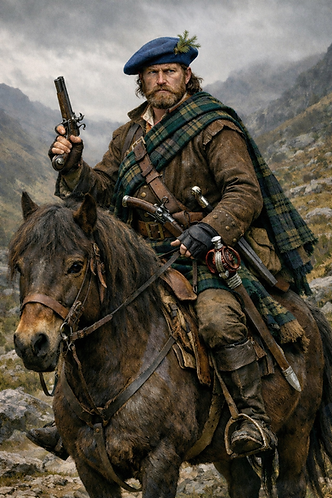
Alaster MacEòs' in Rhinstock, Glen Nochty, Strathdon
John Brabner, likely a grandson of Eòs', settled at Auchernach, next to Toldaquhill, in Glen Nochty, among Farquharson allies, the 'Cattanach' (men of Clan Chattan). We surmise that John had a son, Alaster, who helped anchor our surname, MacEòs'. Alaster fathered seven children at Rhinstock, his highland home at the head of Glen Nochty, at the pastoral limit between Glenlivet and Glenbuchat. As a boundary keeper, he likely oversaw cattle droving and smuggling over the Ladder Hills.
Jacobite Risings

John MacEòs' joins John Erskine, Earl of Mar, at Braemar 1715
Alaster named his first son John after his father. This boy was born in 1686 at Rhinstock, Glen Nochty, and survived the freezing cold 'Seven Lean Years' in the 1690s. The 1707 Act of Union, which created Great Britain, was deeply despised by many in Scotland, who viewed it as a 'sell-out'. In 1715, John Erskine, Earl of Mar, raised the Jacobite Standard at Braemar. John MacEòs' rallied with the Forbeses of Skellater. Vitally, he had a son, William, on the eve of the 'Fifteen', and later raised a family in Cairnie.

James McCose joins John Hamilton, Enzie Battalion, at Aberdeen 1745
John MacEòs', of the 'Fifteen', raised James McCose, of the 'Forty Five'. James was a horse handler for John Hamilton of Sandistoun, Enzie Battalion leader, the Duke of Gordon's factor and Portsoy vintner/smuggler. After proclaiming the 'Pretender' at Aberdeen, Hamilton was captured as the Prince’s rearguard Governor of Carlisle, tried for High Treason, and in 1746 was hanged and beheaded in London. Defence witnesses James and John McCose escaped the dock and implication.
Auld MacEòsaidh

William McCose, former Jacobite, joins Morris's Highlanders, Buxar
William McCose, son of John MacEòs', was baptised in 1715, as his father marched off. His grandfather, Alaster, held him at the font. William lived for 92 years and became known in family lore as 'Auld MacEòsaidh'. He toiled as an army blacksmith, married Jean Christie, and relocated to Gartly, then Marnoch, near Huntly. During the 'Forty Five', he most likely mustered in Lewis Gordon's Jacobite Regiment. In 1759, he joined Morris's (Gordon) Highlanders and served in India at the Battle of Buxar.

William McCose, army veteran blacksmith, Huntly, Strathbogie
Later in his long life, William would tell stories about his military adventures. He no doubt raised many a glass of claret 'over the water', in honour of the Jacobite cause. He likely saw first action at Inverurie on 23 December 1745, under the successful command of Lewis Gordon. There was also a family saying, 'Auld MacEòsaidh of the Royal Écossais', hinting at his action under that regiment, in France, after escaping from Culloden. He subsequently joined the British Army - Morris's (Gordon) Highlanders.
William the Fraser's Highlander

William McCose, recruited by Jane, Duchess of Gordon, American War
William, son of Auld MacEòsaidh, was born in 1758, in Marnoch, near Huntly, on the eve of his father enlisting in Morris's (Gordon) Highlanders. At Elgin in 1776, William was recruited into Captain Hamilton Maxwell's company of the 71st Fraser's Highlanders by his father's Jacobite acquaintance, Lawrence “Old Laurie” Leith of Leith Hall, and undoubtedly through the enchanting allure of Jane, Duchess of Gordon. His company set sail aboard the Anne but was captured by American privateers off Boston.

William McCose, returns from war and raises a family with Elspet Hall
Following a prisoner exchange in late 1778, survivors participated in the Southern Campaign, with their British service ending at Yorktown in 1781. After repatriation, he married Elspet Hall in 1790 near Huntly and worked as a fish merchant. They raised seven children, including a son, William, from whom the present family descends. He died in 1831, one of the few Fraser’s Highlanders who returned home. In recognition, the 16th Lord Lovat graciously received our kindred into Clan of Fraser of Lovat.
1800s

William McCoss, Weaver in Huntly, raised a family with Mary Scorgie
William McCose, the eldest son of the Frasers' Highlander, became a linen weaver in Huntly. He married Mary Scorgie at the end of the Napoleonic Era. Times were tough, and his young brothers struggled. John stole some clothing, was jailed and then served in the 25th Regiment in the Caribbean. James McCose, alias Stuart, a seaman, also stole clothes and was transported to Tasmania, where he perished. For stealing a kettle, George was imprisoned in a hulk on the Thames. He died awaiting transportation.

William McCoss, Baker in Daviot, married Martha Bowman
William McCoss, son of the weaver and Mary Scorgie, was born in 1817. He trained as a baker and rose to master the trade in Daviot, Aberdeenshire. He married Martha Bowman in 1841. Together they had eight children (1842-1857): Martha, William, Elspet, David Bowman, Alexander, John McDonald, Jean and James. Evidently, his baker's business was a prosperous one, and his family thrived compared to the preceding generation. William died aged 69 at 31 Nellfield Place, Aberdeen, on 6 June 1886.
Victorians

William McCoss, married Margaret Macart Brown, Aberdeen
William McCoss, born in Aberdeen in 1844, became a shoemaker in Daviot, running his own shop by 1871. He worked as a salesman in Edinburgh boot warehouses and opened businesses in Leith and Loanhead, surviving debt and setbacks. He married Margaret Macart Brown, his third wife, returned to Aberdeen and founded McCoss & Co., a leather goods manufacturer. Prosperous in later life, he built fine homes in Cedar Place and Cults, retired to Banchory, and died there aged eighty-four in 1928.

David Bowman 'Bobs' McCoss, decoy for Lord 'Bobs' Roberts
David Bowman 'Bobs' McCoss, born 1848, was the eldest of William's younger brothers and a highly decorated soldier: Afghan Medal with three clasps for Charasiab, Kabul, and Kandahar; Afghan or Bronze Star (Kabul to Kandahar); Egypt and Sudan Medal; Khedive’s Star; Long Service and Good Conduct Medal. He served in the Gordon Highlanders, Duke of Albany's Own Highlanders and the Seaforth Highlanders, and had the rank of Colour Sergeant. Remarkably, he was Lord Roberts' decoy.
Victorians

John MacDonald MacCoss, married Agnes Turnbull, settled in Cumbria
John MacDonald MacCoss, born 1852, was a gardener whose working life unfolded in northern England. Born in Aberdeen, the third son of baker William McCoss, he began as a farmhand before moving to Perthshire and later to Cumbria. In 1879, he married Agnes Turnbull of Bo’ness. They settled at Dacre and later Rydal, where he was the head gardener at Rydal Hall. By 1901, he ran a market-gardening business at Greysouthen, raising a large family. Descendants include leading British scientists.

James McCoss, married Anna Beata Nilsson, settled in the USA
James McCoss, born 1857, was a hotel employee and later apartment superintendent who emigrated to the United States. Born in Daviot, Aberdeenshire, the fourth son of baker William McCoss and Martha Bowman, he worked in Edinburgh before leaving Scotland in 1886. After a first marriage to Jane McCallum, he settled in New York, marrying Swedish-born Anna Beata Nilsson in 1889. He managed apartment buildings in Manhattan, raising a family there. Descendants settled in Minnesota.
Era of World Wars

William Leith Pittendreigh McCoss married mathematician Ellen Hunter
William L.P. McCoss, born in 1887 in Loanhead, grew up in Aberdeen and entered the family firm McCoss & Co., becoming a leather goods salesman before managing it around 1920. An accomplished church organist, he married mathematician Ellen Hunter in 1922. During WWII he expanded the business into military webbing and later golf-bag manufacture. He lost his younger brother, James Renouf Bruce McCoss, to a Nazi blitz on Aberdeen on 12 July 1940. William died peacefully in Dundee in 1974.

James 'Hamish' McCoss, Matterhorn mountaineer
James 'Hamish' McCoss, born 1883, was the son of James McCoss, born 1857 in Daviot. He was another of the grandsons of the master baker. James was an accomplished mountaineer. In 1912, he joined the Cairngorm Club; in 1919, he was elected to the Club Committee; and in 1931, he was elected president. He climbed the Matterhorn and gave an excellent account of the ascent in the June 1936 journal. He also took a keen interest in astronomy and played the bagpipes.
Global Enterprise

Leslie Hunter McCoss, Nainital, Himalayan foothills
Leslie Hunter McCoss was born in 1929 to William and Ellen, and was a co-founder of the 'Amphians' sport-diving club. Post-WWII, he served with the Royal Engineers in Hameln, wearing his squadron's “Desert Rats” motif. He worked with the English Electric Company in India on the Khatima Hydroelectric Project. Les married Alison Murray from Ayr in 1958 and then developed a successful adventure sports business in Tayside and Speyside. He passed peacefully in Fife in 2016.

Angus Murray McCoss, Geologist, East African Rift Valley
Angus Murray McCoss was born in 1961 to Les and Alison. A keen member of his school’s Black Watch CCF, he attained the rank of Colour Sergeant. He studied geology at university, gaining a PhD in 1987. He married Karen James in 1984, and together with their young family, they embarked on a series of international assignments following Angus's career in geology. Postings included the Netherlands, China, Oman, Argentina, and Nigeria. He now works on enabling the UK's clean energy security.